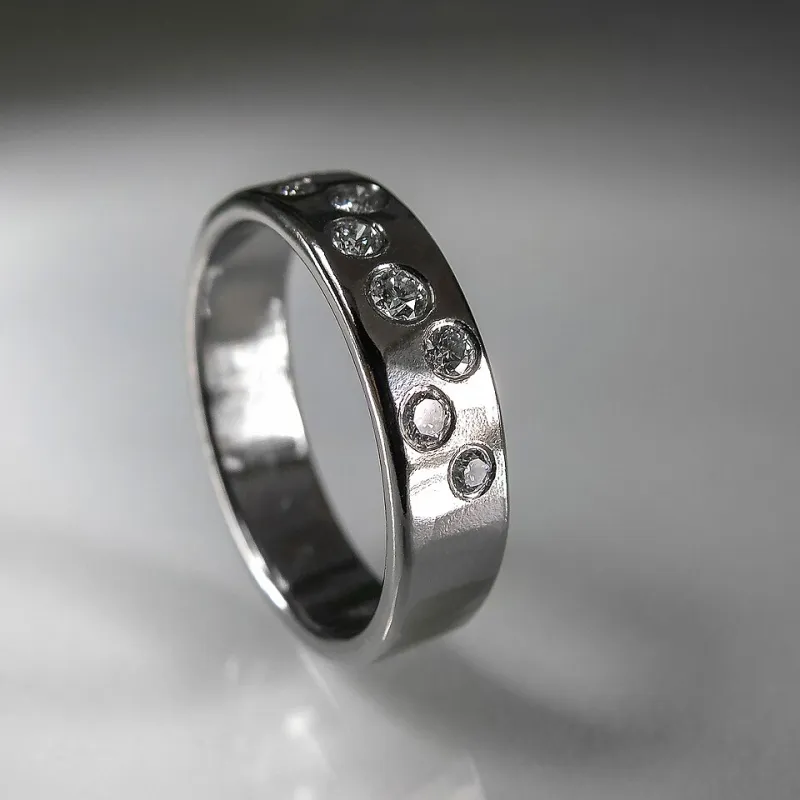
The Box on the Christmas Table: What to Do When Jewellery Comes Down Through the Family

Photo: Basher Eyre , CC BY-SA 2.0, via Wikimedia Commons
Christmas lunch has a habit of producing two things: too much pudding, and one small box that gets pushed across the table with the words "we thought you should have this". Inside is a ring, a brooch or a strand of pearls that belonged to someone you loved — and suddenly you're holding family history and a quiet sense of panic at the same time.
That's completely normal. An inherited piece doesn't need a decision by teatime, or even by New Year. What it does need is a calm, sensible process that protects the story and the value in equal measure. Here's the approach we'd suggest.
Resist the urge to tidy it up
The first instinct is usually to polish it, soak it, or drop it into the nearest shop for a quick clean. Wait. Older settings are often softer than they look, pearls and opals dislike ultrasonic tanks and chemical dips, and emeralds are famously unforgiving of both. A gentle wipe with a soft, dry cloth is plenty for now; anything more can wait until someone qualified has actually looked at it.
The same applies to resizing. A ring that's been worn thin at the back needs attention before it goes on a finger for a big night out — not after.
And keep everything that came with it. The box, the scrappy note in your grandmother's handwriting, the 1970s insurance schedule, the photo of her wearing it. Provenance is part of what a piece is, emotionally and occasionally financially.
Learn to read the hallmarks
If the piece is gold, silver or platinum, there's a good chance it carries a UK hallmark — essentially a passport stamped on the metal. Look for three compulsory marks:
- The sponsor's (or maker's) mark — who submitted it for testing.
- The assay office mark — where it was tested. The leopard's head for London, the anchor for Birmingham, the rose for Sheffield, the castle for Edinburgh.
- The fineness mark — 375 for 9ct gold, 750 for 18ct, 916 for 22ct, 925 for sterling silver, 999 for fine silver or gold, and 950 for platinum.
Many pieces also carry a date letter, which can help narrow down the year, although the lettering systems differ between assay offices and reset over time.
Two caveats worth knowing. Some older or very light pieces were legally exempt from hallmarking, so an absent mark proves nothing either way. And hallmarks describe the metal, not the stones — a diamond or a sapphire needs a jeweller's eye, not a magnifying glass and optimism.
Take a proper look at the condition
Before it goes anywhere near a finger or a neckline, check the boring bits. Claws wear down and stones work loose. Shanks thin. Clasps on brooches and bracelets are the usual point of failure. Pearls are strung on silk, which stretches and perishes, so a strand from the 1970s has almost certainly been restrung since — and if it hasn't, it should be. Hollow links kink, fine chains snap, and old screw-back earrings can lose their tension.
None of that is a disaster. It's maintenance, and most of it is inexpensive compared with the piece itself.
Two very different numbers
People often ask what something is "worth", as if there's a single answer. There are usually two:
- Insurance replacement value — what it would cost to buy something comparable, new, from a jeweller. This is the figure your insurer wants.
- Second-hand or market value — what a dealer, auction house or private buyer would actually pay. This is nearly always lower, sometimes considerably.
Ask for a written valuation from someone qualified, with photographs and a full description. Look for a valuer registered with a recognised professional body, or a jeweller willing to put their assessment in writing and stand behind it. Expect to pay for the service — a proper valuation takes time and a loupe, and a free one is usually a sales conversation in disguise.
Then, and only then, deal with the insurance
Most home contents policies cover individual items up to a limit — often somewhere between £1,000 and £2,500 — and anything above that needs to be listed as a specified item, with a valuation on file. If the piece is going to be worn regularly, check whether the policy covers accidental damage and loss away from home, not just theft from the house.
Keep the valuation, photographs and any receipts somewhere separate from the jewellery itself. Revisit the figure every few years, particularly when metal prices have moved sharply.
The family conversation
This is the part nobody puts in the guidebooks. Inherited jewellery arrives with feelings attached — yours, your siblings', your mother's. Give yourself four honest options rather than one rushed decision:
- Wear it as it is. Often the best answer. A piece in use is a piece being looked after.
- Restore it. New claws, a new shank, a restring. Conservation rather than change.
- Restyle it. Stones reset into a mount that suits your life.
- Archive or share it. Documented, stored properly, and passed on again — or divided fairly between family members.
There's no rule that the eldest gets the ring, or that the person who inherits has to keep it. A piece that sits unworn in a drawer for thirty years isn't being honoured; it's being stored.
If you restyle, keep the original
Resetting stones into a new mount is a genuinely lovely way to bring an heirloom into your own life. Just ask the workshop to return the original setting and any removed metal, and photograph the piece before it's altered. If your feelings change in a decade — and they might — you'll still have the option to put it back.
If you're thinking of selling
Get at least three quotes. Understand that a dealer's offer reflects scrap metal value plus what they think they can sell the stones for, which is rarely the retail figure in your head. Signed pieces from the big houses behave differently and are better placed with a specialist or an auction house. And be wary of postal "we buy gold" services that make their margin on the fact that you can't see the piece again once it's gone.
A short checklist for the handover
- Photograph the piece from every angle, including the marks.
- Keep the box, paperwork and any family notes together.
- Have the hallmarks read by someone who knows what they're looking at.
- Get a written valuation before insuring it.
- Add it to your policy as a specified item if it's over your contents limit.
- Book any repairs with a proper workshop rather than a high-street chain.
- Store it separately from the pieces you wear every day.
- Decide with your family, not for them.
Inherited jewellery is rarely just jewellery. It's a person, a decade, a set of hands. Treat it with a bit of patience and it will keep doing that job for a long time yet.